


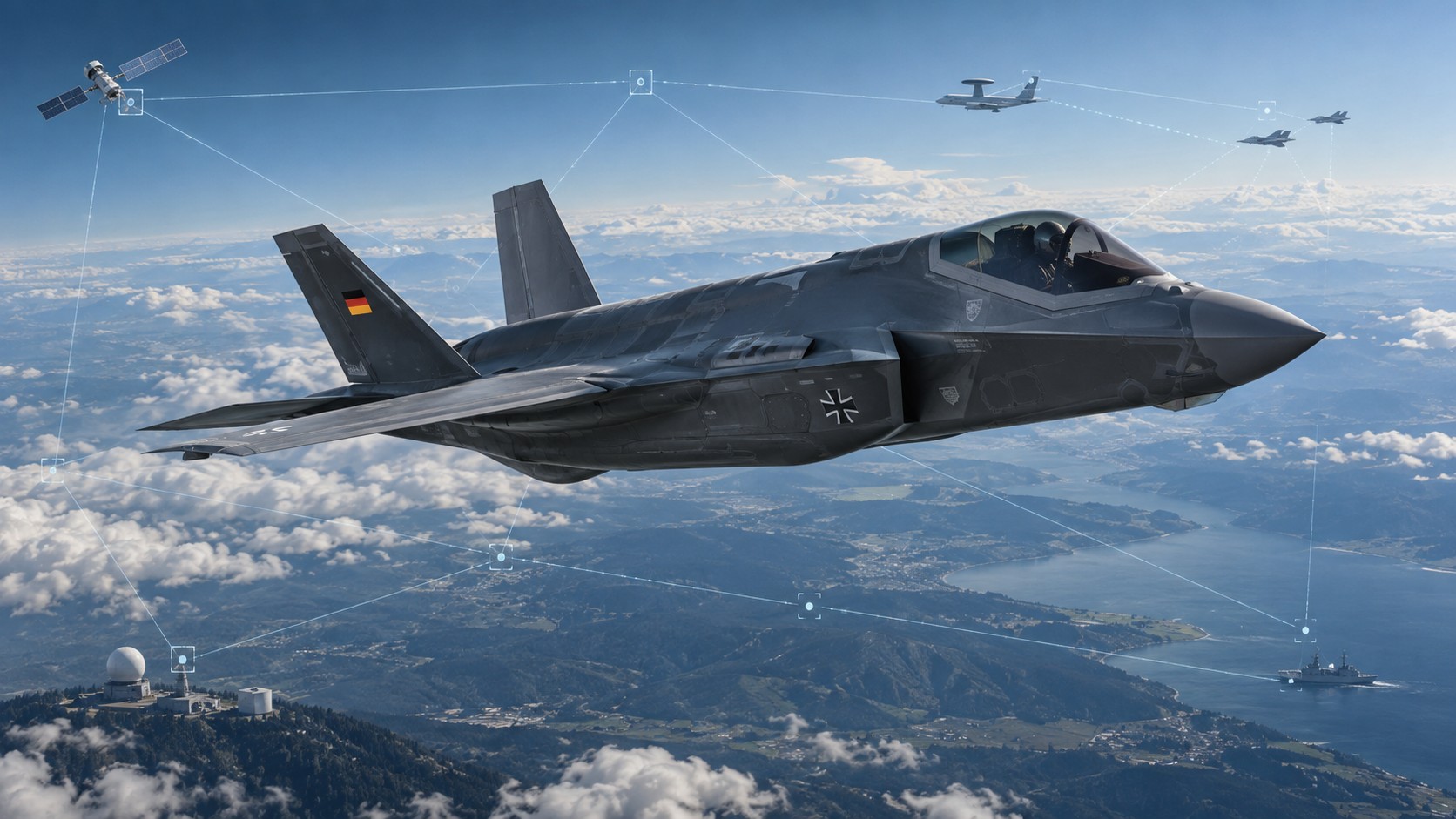
Symbolic representation; AI-generated.
The Maiden Flight as the Beginning of a Technological Transition
On September 8, 2026, the first flight of an F-35A built for the German Air Force took place at the Lockheed Martin facility in Fort Worth. The first eight German aircraft are to be used at Ebbing Air National Guard Base in Arkansas for flight and technical crew training; the arrival of the first aircraft in Germany is expected in late 2027, with initial operational capability planned for 2028. The publicly confirmed procurement volume stands at 35 aircraft. Reports regarding a possible expansion of the fleet have surfaced; however, as of February 19, 2026, the German government stated that no decision on an additional order exists. Therefore, stating that 50 F-35s have already been ordered would be premature.
The significance of the maiden flight goes beyond the modernization of aviation hardware. The F-35 is a software-dependent networked platform: its capabilities are shaped by the combined operation of onboard sensors, computing systems, data exchange links, mission planning tools, ground-based IT infrastructure, and logistics support. Software fuses data from disparate sensors and generates an integrated situational picture for the pilot; aircraft within a flight can share portions of this information and operate as elements of a unified reconnaissance-strike network.
Consequently, the transition to the F-35 alters not only the flight performance characteristics of German military aviation, but the very model of its combat capability. This capability depends increasingly on data integrity and currency, the availability of digital services, communications resilience, and the physical and logical security of ground infrastructure. The maiden flight marks the beginning of a transition from a Cold War-era platform to a distributed digital warfare system—bringing new capabilities alongside a new structure of technological risks.
Political Background
The procurement of the F-35 was preceded by a multi-year debate over the replacement of the Tornado. These aircraft conducted conventional strike missions, tactical reconnaissance, electronic warfare, and fulfilled Germany's role in NATO's nuclear deterrence mechanism. By the early 2020s, the aging fleet, logistical complications, and rising maintenance costs made a replacement urgent: the federal government expected that operations after 2025 would become increasingly difficult, and no later than 2030, economically unfeasible and operationally risky.
Initially, the Eurofighter, F-15, F/A-18, and F-35 were considered. In early 2019, Minister of Defense Ursula von der Leyen excluded the F-15 and F-35 from further consideration, leaving the Eurofighter and F/A-18. According to a subsequent government response to the Bundestag, the decisive factors were the more predictable technical risks of the two remaining options, the anticipated cost-benefit ratio, and, regarding the F-35, political commitment to the European NGWS/FCAS program.
In 2020, the Merkel government considered a split solution: the Eurofighter for part of the conventional roles, the F/A-18F Super Hornet for nuclear sharing, and the EA-18G Growler for electronic warfare. This approach aimed to preserve transatlantic compatibility while supporting the European industrial base.
Industrial policy logic required supporting the Eurofighter without weakening the prospects of a next-generation European system. In 2019–2020, Berlin attempted to reconcile these priorities without procuring the F-35. Germany participated in the production of the Eurofighter and possessed the associated engineering competencies, infrastructure, and workforce. Additional orders were intended to sustain this industrial foundation until the arrival of the next generation of systems. FCAS, launched by Germany and France in 2017, was envisioned not merely as a new fighter, but as a system linking a crewed platform, uncrewed aerial vehicles, sensors, weapons, and a combat cloud. Its long-term strategic purpose was to preserve Europe's capacity to autonomously develop complex aerospace and digital technologies.
Why the Decision Changed After 2022
The return of the F-35 to German defense deliberations began prior to the outbreak of the war in Ukraine: in January 2022, the incoming government of Olaf Scholz re-examined this option. The primary driver was schedule risk. The Tornado was scheduled to be retired by 2030, whereas a European next-generation fighter was not expected until the 2040s. The longer the selection was deferred, the higher the probability became of a capability gap between the phase-out of the legacy platform and the operational availability of its successor.
Following February 24, 2022, the political weight of urgency increased sharply. In his Zeitenwende address on February 27, 2022, Scholz linked the modernization of the Bundeswehr to the deterioration of European security, announced a €100 billion special fund, and explicitly identified the F-35 as a prospective carrier for nuclear sharing. On March 14, the Ministry of Defense announced the selection of the F-35A and plans to procure 35 aircraft; electronic warfare missions were to be transferred to an advanced variant of the Eurofighter.
The nuclear mission significantly narrowed the field of choice. Germany does not possess its own nuclear weapons, but under NATO nuclear sharing arrangements provides aircraft and trained aircrews for the potential delivery of U.S. munitions following the requisite political authorizations. The Tornado successor therefore had to undergo a U.S.-controlled certification process for the B61-12. At the time of the German decision, final certification of the F-35A had not yet concluded, but bomb integration was already part of the U.S. program schedule and was considered a lower timeline risk than certifying an entirely new platform. Certification of the F-35A was completed on October 12, 2023.
Interoperability with allies provided an added advantage. By March 2022, eight European NATO member states were already operating the F-35 or were in the procurement process. This granted Germany access to a shared infrastructure for training, supply, maintenance, and operational interaction. Taken together, operational urgency, the nuclear delivery mandate, and the availability of a serial-production allied platform altered the hierarchy of priorities: European industrial autonomy retained its relevance, but ceased to be a sufficient reason for further postponement.
The F-35 as a Cyber-Physical System
In cybersecurity analysis, it is useful to evaluate the F-35 as a distributed cyber-physical system. This is not an official manufacturer designation, but a method to describe the reliance of the aircraft's physical flight and combat capabilities on software, sensors, data transmission channels, mission planning systems, ground IT, and global technical sustainment. The aircraft remains the central element, but its operational effectiveness is generated across the entire digital ecosystem.
Onboard software correlates data regarding the air, surface, and electromagnetic operational environment to create an integrated picture. A critical role is played by Mission Data Files—compiled datasets that facilitate signal recognition and threat classification in a specific theater of operations. When core operating software is modified, these data files must be adapted, verified, and reloaded. Therefore, their currency and integrity represent operational prerequisites for the correct functioning of the sensor suite, rather than secondary administrative functions.
This yields three foundational information security requirements:
- Confidentiality: A compromise of confidentiality can expose intelligence regarding recognized threat profiles and operational employment scenarios.
- Integrity: A breach of integrity can distort target classification or system configuration parameters.
- Availability: A loss of availability can delay mission planning, maintenance turnarounds, and return-to-service cycles. A critical operational effect does not necessarily require a total system shutdown: latency in data transmission, diagnostic telemetry, or software updates is sufficient to depress sortie generation rates.
Digital dependence continues on the flight line. The ALIS system, which is being gradually replaced by the Operational Data Integrated Network (ODIN), supports fleet maintenance, supply chain management, and readiness reporting. The F-35 Joint Program Office describes ODIN as a cloud-native architecture with an integrated data environment and modular software applications; ODIN encompasses not only a software service, but also deployed hardware, networking components, and operational support infrastructure based directly at operating wings.
Cloud and network integration accelerates capability delivery, but elevates the importance of access control, secure network gateways, patch verification, and fallback procedures. In a conflict, an air base may face cyberattacks, electronic warfare, communications disruption, or severance from remote off-base services. Consequently, practical cyber resilience requires the capability to sustain essential functions in a degraded or disconnected mode, recover from operational disruptions, and verify configuration compatibility across the entire chain—from the aircraft and mission data down to ground support applications.
Digital Dependence and Technological Sovereignty
Evaluating sovereignty requires distinguishing between political-operational command and control over the technological life cycle. Germany will own the airframes, train the crews, establish operational units, and independently decide upon their deployment. However, this does not equal sovereign national control over core software, technical documentation, baseline configurations, updates, or weapon integration.
The procurement is conducted through the U.S. Foreign Military Sales mechanism. The approved package encompasses not only aircraft, engines, and ordnance, but also classified operational software, software development and integration support, electronic warfare systems, access to reprogramming laboratories, logistics systems, and contractor services. This framework grants Germany access to a U.S.-supported weapon system, but does not transfer the full underlying technology or intellectual property rights.
Baseline system architecture and the clearance of new software increments are governed centrally by the F-35 Joint Program Office. Germany can formulate operational requirements and coordinate with other user nations, but does not obtain unilateral rights to alter core software or integrate domestic weapons into the certified configuration. While this unified policy prevents incompatible national variants, it directly ties the modernization timeline of the German fleet to U.S. programmatic decisions and schedules.
This challenge is not unique to Germany. According to assessments by the U.S. Government Accountability Office, the U.S. Department of Defense itself has experienced significant reliance on Lockheed Martin for F-35 sustainment and has lacked elements of the technical data needed to transition sustainment functions from contractor to government personnel. As of March 2026, several GAO recommendations regarding IT systems, maintenance, and technical data rights remained only partially implemented. For a foreign operator, this structural asymmetry is at least as pronounced.
Berlin is seeking to localize those support functions accessible to an FMS operator. The involvement of Rheinmetall and a German industrial consortium is intended to establish domestic capacity for component manufacturing, maintenance, repair, and overhaul. In parallel, a secure IT infrastructure is being procured specifically for the German F-35A operating environment, including network security gateways, specialized hardware, software, and systems administration training. These steps improve domestic resilience and technical competency, but do not equate to sovereign control over the platform's overarching technical architecture.
In November 2022, the federal government stated to the Bundestag that, in its assessment, the potential for increased dependence on the U.S.—including in the digital domain—did not constitute an unmanageable risk. At the same time, it identified reducing reliance on non-European defense suppliers as an established objective for joint European projects, national research initiatives, and the replacement of U.S.-regulated components where feasible. These two positions demonstrate the distinction between accepting alliance-based dependencies within a specific acquisition program and pursuing a long-term policy to sustain an independent defense technology base.
Geopolitical Synthesis
The procurement of the F-35 solidifies Germany’s posture within NATO: it guarantees the continuity of nuclear sharing following the retirement of the Tornado and embeds the Luftwaffe within a growing community of common platform operators. Harmonized operational tactics, training pipelines, ordnance, logistical support, and digital services facilitate the generation of multinational composite wings. However, this interoperability is achieved not merely through shared alliance standards, but through the integration of the national air force into a technological ecosystem whose core resides in the United States.
Under standard alliance conditions, this model provides economies of scale: research and development expenditures, spare parts inventories, and support infrastructure are distributed across multiple operators. Geopolitical friction arises if operational or strategic interests diverge significantly, as influence can be exerted through spare parts prioritization, technical support availability, and the timeline for integrating capability upgrades. This dynamic does not infringe upon Berlin's legal authority to deploy its own aircraft, but it conditions its capacity to autonomously manage their development throughout the complete life cycle.
The Eurofighter continues to serve as a partial counterweight. The procurement of Tranche 5 aircraft approved in 2025, alongside the development of an airborne electronic attack variant, sustains European aerospace engineering capabilities, flight-test facilities, and industrial manufacturing capacity. The Eurofighter thereby fulfills both an operational mission and an industrial policy role, preventing Germany's tactical air fleet from relying exclusively on a single American platform.
FCAS was intended to provide a long-term technological alternative, but in June 2026, Germany and France halted joint development of its central combat aircraft component following the breakdown of negotiations between Airbus and Dassault over program leadership, workshare allocation, and intellectual property rights. While select digital and uncrewed elements may proceed, a unified Franco-German next-generation fighter platform no longer exists in its planned form. Consequently, FCAS should be characterized not as an assured instrument of future autonomy, but as an illustration of the obstacles involved in translating political objectives of European sovereignty into a sustainable industrial program.
The resulting framework is structurally asymmetric. The operational component of Germany’s strategy—the F-35, nuclear sharing, and NATO integration—is anchored by signed contracts, active production lines, and dedicated infrastructure. The European component rests primarily on the further evolution of the Eurofighter, while the architecture for its successor remains undefined. As the F-35 user base expands across Europe, the systemic advantages of the common ecosystem increase, making an organizational and technological transition to an alternative system progressively more costly.
Germany selected an immediately accessible military capability with a defined delivery timeline. While this choice enhances its defense capability and alliance posture in the near and medium term, it simultaneously consolidates the role of the United States as the provider not merely of an airframe, but of the complete software, information, and logistical life-cycle architecture that sustains it.
Sources
Fact-checking and source verification: September 9, 2026.
- The Aviationist. Germany’s First F-35 Has Flown. September 8, 2026.
- Lockheed Martin. Germany’s First F-35A Advances to Final Assembly. March 23, 2026.
- Bundesministerium der Verteidigung. F-35: Nachfolger für den Tornado. 14. März 2022.
- Deutscher Bundestag. Drucksache 19/32618: Transparente Entscheidungskriterien für die Tornado-Nachfolge. 29. September 2021.
- Reuters. Germany drops F-35 from fighter tender. January 31, 2019.
- Bundeswehr. F/A-18 und Eurofighter senden starkes Signal an NATO-Partner. 16. März 2020.
- Stiftung Wissenschaft und Politik (SWP). Tornado-Nachfolge: Sonderweg mit Tücken. 22. April 2020.
- Defense News. New German government revisits Tornado replacement options. January 10, 2022.
- Presse- und Informationsamt der Bundesregierung. Regierungserklärung von Bundeskanzler Olaf Scholz zur Zeitenwende. 27. Februar 2022.
- NATO. Standardization. Updated October 14, 2022.
- U.S. Department of Defense Inspector General. Evaluation of the Air Force’s Nuclear Certification of the F-15E, B-2, and F-35A Aircraft. May 2, 2024.
- Breaking Defense. F-35A officially certified to carry nuclear bomb. March 8, 2024.
- F-35 Joint Program Office. ALIS and ODIN Overview. n.d.
- U.S. Air Force. F-35 mission data programmers recognized by Air Force. November 3, 2017.
- Director, Operational Test and Evaluation (DOT&E). F-35 Joint Strike Fighter: FY 2023 Annual Report. 2024.
- U.S. Government Accountability Office (GAO). F-35 Aircraft: DOD and the Military Services Need to Reassess the Future Sustainment Strategy. September 21, 2023; status updated 2026.
- Defense Security Cooperation Agency (DSCA). Germany – F-35 Aircraft and Munitions. Transmittal No. 22-53, July 28, 2022.
- Deutscher Bundestag. Drucksache 20/4525: Rüstungsprojekte und Beschaffungsorganisation der Bundeswehr. 17. November 2022.
- TED – Tenders Electronic Daily. Auftragsbekanntmachung 513776-2026: Sichere IT-Infrastruktur für den Einsatzbetrieb F-35A. 2026.
- Rheinmetall AG. Rheinmetall Aviation Services: Kompetenzzentrum für moderne Kampfflugzeuge. o. D.
- Bundeswehr. Eurofighter Tranche 5 geht in Produktion: Deutschland erhält 20 Stück. 15. Oktober 2025.
- Europäische Sicherheit & Technik. Deutsches Industriekonsortium für die Wartung der F-35 formiert. 19. September 2023.
- Bundesministerium der Verteidigung. Beschaffung: Eurofighter der Tranche 5 für die Luftwaffe gebilligt. 8. Oktober 2025.
- ZDFheute. Warum der deutsch-französische Kampfjet gescheitert ist. 8. Juni 2026.
- Breaking Defense. No, there’s no “kill switch”: Pentagon tries to reassure international F-35 partners. March 18, 2025.